 Silas North · Field Notes From Enough · June 6, 2026
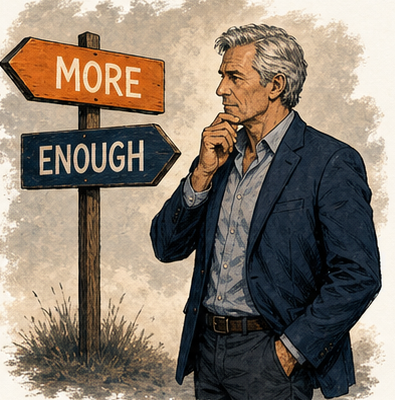
There comes a point in a successful man’s life when more stops paying the same rate.
Not because money becomes useless. That is the kind of thing only people with money say too casually.
Money matters. Security matters. The ability to absorb bad news without asking permission matters. Anyone who tells you otherwise is either selling enlightenment or has never had to make payroll.
But there is a moment — usually later than it should be — when the pursuit of more starts returning less.
Another deal. Another account. Another title. Another year of proving something to people who stopped keeping score ten years ago.
For a lot of men entering their early sixties, life has been one long climb: careers built, families supported, risks taken, losses swallowed quietly, numbers beaten, then beaten again.
That engine is useful. It builds things. It feeds families. It turns fear into structure and ambition into a house with the lights on.
But engines do not know when they have arrived.

They just keep running.
And that is where successful people get into trouble. Not because they failed. Because they won and never adjusted the scoreboard.
At some point, the most valuable asset is no longer money.
It is time.
Not calendar time. Healthy time. Mobile time. Clear-headed time.
The kind where your knees work, your friends are still here, your spouse still wants to go, and the calendar has not started filling with doctors and absences.
That time is finite. And it passes faster than men who are good at building things want to admit.
The next ten or fifteen years will not feel like the last thirty. They will move differently. Faster. Quieter. With fewer warnings. One day you are “still young enough.” Then suddenly the trip gets harder, the recovery takes longer, and the calendar starts collecting absences.
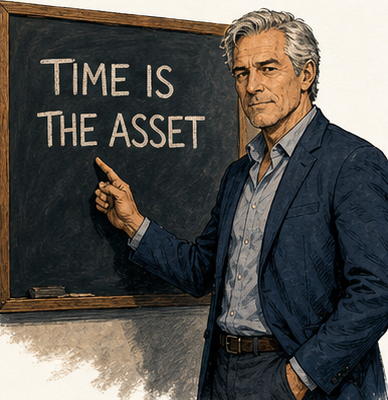
No amount of money buys back healthy years once they are gone.
That is the brutal math.
A successful man can insure the house, the business, the liability, the estate, and the damn watch on his wrist.
But he cannot insure the Saturday morning he skipped, compound the dinner he delayed, refinance the vacation he promised, or buy back the version of himself who could sit on a porch without checking the market.
And still, too many men keep telling themselves the same expensive lie:
Later.
Later is the favorite word of people who believe life owes them an extension.
Later, when this deal is done. Later, after the next number. Later, when the market settles. Later, when the business runs itself. Later, when the kids are older. Later, when the schedule opens. Later, when I can finally relax.
Later is a beautiful word until it becomes a receipt.
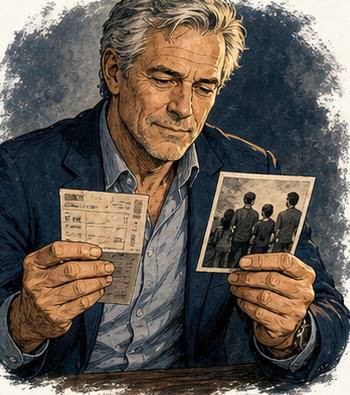
The final phase of life does not have to be a retreat from purpose. That is another bad story successful people tell themselves. They confuse slowing down with surrender.
Nonsense.
Purpose changes shape. It can look like mentorship, friendship, availability, teaching what cost you twenty years to learn, or walking away from the table before the table owns you.
Because daylight is the real currency now: mornings, health, a clear mind, people you love still close enough to touch, and the freedom to choose a Tuesday for no reason. That is wealth. The rest is inventory.

This does not mean quit everything, sell the house, buy linen pants, and start talking about “vibrations.” Please don’t. The world has suffered enough.
It means look honestly at the trade. If the next dollar costs you a year you could have lived, what exactly did you buy? If the next milestone requires postponing the relationships that made the whole climb worth it, who is winning? If the habits that created success now prevent you from enjoying it, are they still virtues — or just addictions with better accounting?
There is no medal for being the richest man in the waiting room.
Too many successful people end up there: waiting to travel, reconnect, forgive, call, teach, rest, and become the version of themselves they promised would show up eventually. Then the body changes. Or the phone rings. Or the grandkids stop asking because they learned the answer.
The scoreboard changes quietly.
The summit was never supposed to be a place you sprinted past. It was supposed to give you a view.

Too many winners reach the top and immediately look for the next ridge because the climb is the only language they trust. Still moving. Still proving. Still trying to outrun the fear that built them.
But fear is a terrible retirement plan.
At some point, enough is not weakness, quitting, or a lack of ambition.
Enough is command.
It is the discipline to recognize that the game changed before the machine eats the man who built it.
So take the trip. Make the call. Sit at the table. Teach the kid. Visit the friend. Walk while your legs still negotiate in good faith. Love people while they can still feel it.
Spend some of the money on memories before it becomes numbers in a file handled by people using words like “estate” and “distribution.”
You built. You carried. You protected. You won more than you probably let yourself admit.
Now comes the part that requires a different kind of courage: stop running long enough to notice.
You already won. Stop running.
— Silas North